HYDRA
will consist of a modular and expandable circuit of pressurized pipes of the two core experimental arrangements, i.e., a looped (HYDRA-L) and a single-pass (HYDRA-SP) network, along with other physical components of a water system (e.g., storage and drainage tanks, pumps, isolation and outlet valves), which will allow the configuration of alternative network topologies and scales, under a wide range of operating conditions and scenarios.
In terms of operations, water in HYDRA will supplied by the main recirculating network of LoAH, and all outflows will be collected into the drainage tank which has a twofold operation;
Store and re-circulate water
to minimize consumption
Isolate volumes
containing chemical or biological agents, to maximize safety and avoid their recirculation in the LoAH system. HYDRA-L serves as a distribution system emulator for domestic (small diameter pipes) and industrial intakes (larger diameter) at main and sub-main scales.
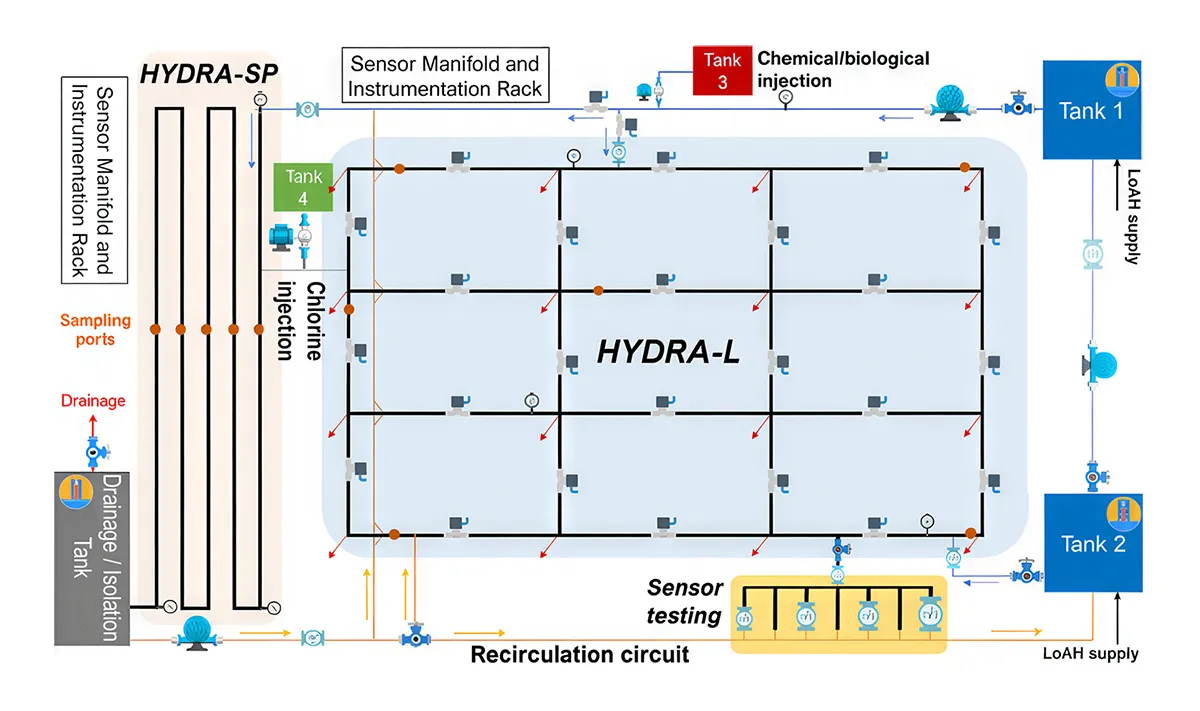
Conceptual design of the HYDRA experimental facility
The facility can recreate multiple topologies and operational conditions, though the remotely controlled valves at each link and the feeding pumps, and accommodate different consumption levels (household, industrial etc.) and time varying demand patterns via the adjustable, remotely controlled outflow valves at each node. Thus, HYDRA is not as a “fixed” facility, but rather a modular, case-evolving infrastructure that can realistically reproduce a wide range of real-world dynamic conditions, at both spatial and temporal level.
As the recirculation of water within loops affects quality related measurements, e.g., measure a contaminant multiple times, HYDRA adheres to the international laboratory standards, and provides a single-pass arrangement to test the minimum threshold, accuracy, and reliability of both hard and soft-sensors for drinking water quality parameters such as the concentration of chemical (lead, arsenic, nitrates, pesticides etc.) and biological agents (e.g. coliform and intestinal enterococci bacteria), or the detection of micro-plastics, on top of typical parameters, (e.g. PH, temperature, turbidity, etc.). Both arrangements are equipped with a series of sampling ports and sensor placeholders (various diameters) for new sensors to tap in, with minimum adjustments or retrofitting.
The physical system will be complemented by state-of-the-art digital tools and ICT services to monitor hydraulic and quality parameters in real time (e.g., flow, velocity, pressure head, pH, turbidity, chlorine residual, temperature) and allow for experimentation with remote, programmable, and automatic control and scheduling (e.g., pressure reduction valves, adjustable outlet, isolation valves), while the installed state of art sensors serve both as a benchmark/reference for other smart technologies, and as data providers for the population of datasets for training new soft-sensors and calibrating models.
By combining advanced sensors and remotely controlled equipment with powerful analytical tools and software, researchers will be able to conduct experiments and test out new software and water management strategies in a controlled environment and refine them for use in real-world conditions.